
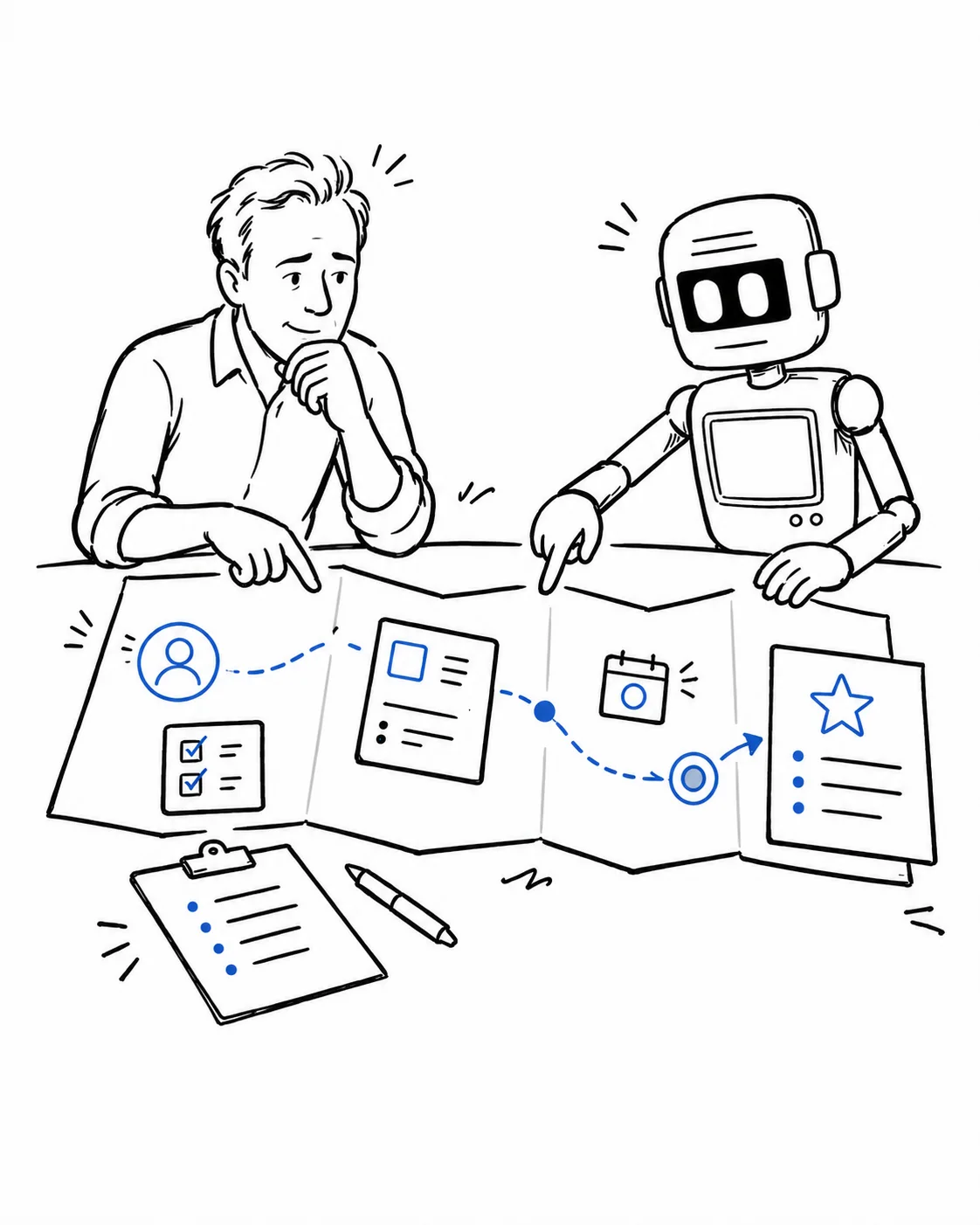
Most small teams do not need an “AI transformation.” They need one useful improvement they can understand, review and stop if it is not helping.
Unbox the workflow before you add AI to it.
See the task, information, decisions, handoffs, risks and human responsibility first. Look for repeated gathering, organizing, comparing, preparing, adapting or drafting around a decision a person still owns. Then decide whether AI genuinely improves any part of it.
A promising first use usually has:
- A repeated task with a recognizable beginning and end.
- Inputs the team is allowed to use.
- A clear standard for what good output looks like.
- A person with time and authority to review the result.
- A consequence low enough to test safely.
- A practical measure such as fewer repeated steps, faster preparation or a stronger first draft.
AI cannot repair an upstream decision problem.
This is why we unbox the work before choosing the tool. If every request is urgent, approvals are unclear, source information is unreliable or nobody owns the final decision, automation may make the confusion move faster. Clarify the process before adding AI to it.
Keep these responsibilities visibly human.
- High-consequence decisions affecting health, safety, employment, eligibility, legal rights or financial access.
- Sensitive relationships where dignity, consent and context matter.
- Claims that require evidence or professional accountability.
- Ambiguous situations where the organization has not decided what it believes or permits.
- The distinctive standards and judgment people trust the organization to carry.
Responsible use is not a disclaimer at the bottom of an AI-generated document. It is a visible workflow: permitted inputs, defined assistance, a human reviewer, a quality standard and a person accountable for the decision.
A practical first pilot
- Name one recurring responsibility.
- Separate the human decision from the support work around it.
- Choose one low-consequence portion for AI assistance.
- Define what information may and may not be used.
- Create an example of acceptable output.
- Assign a reviewer and stopping condition.
- Test long enough to compare the new process with the old one.